

Audio
Cutting To The Chase
Tariffs were a hot issue before the U.S. Civil War (1861-1865), just as they are now. The U.S. contained two increasingly different economies: an industrialising North favouring protection and an agricultural South connected to global markets through cotton produced by slave labour.
Money finances war. Restrict money creation through a currency based on gold or silver, and wars become harder to sustain.
During the Civil War, the Confederate South thought Britain’s dependence on its cotton would force British intervention. It did not. Dependence is not obedience.
Britain’s cotton famine exposed the danger of relying on one supplier; the South’s experience exposed dependence on one export. Taiwanese semiconductors, Chinese rare earth processing, pharmaceutical ingredients and Gulf oil routes carry similar risks today. Substitution takes time and can be brutally expensive.
The Southern cotton boom of the 1830s benefited from expanding bank credit and government support. Its defenders then demanded “free trade”. We still overlook how the monetary system shapes the trading interests people defend. In addition, do I even need to point out that slavery and government subsides is hardly free trade to begin with.
Britain abolished its slave trade in 1807 while continuing to buy American slave grown cotton. Today, we condemn forced labour in China while buying products from supply chains implicated in it. Cotton, of all things, still connects the stories.
In 1862, hungry Manchester workers supported the abolition of American slavery even as wartime cotton shortages destroyed their livelihoods. In November 2023, American business leaders gave Xi Jinping a standing ovation at dinner in San Francisco, despite forced labour in China’s cotton and other industries. What was on the menu?
The United States restricts imports linked to Xinjiang forced labour. China’s April 2026 rules can punish compliance with foreign measures Beijing designates improper. Commercial dependence can therefore become a legal trap.
Lincoln’s government introduced greenbacks in 1862: federal paper creditors generally had to accept, without a right to demand gold. Federal bond interest remained payable in coin. Printing helped finance the war while distributing its costs unequally. Paper for some. Gold for others.
Hyperinflation destroyed Confederate currency’s purchasing power, while defeat in 1865 left its cotton bonds worthless. The Union honoured its debt and restored greenback redemption in gold in 1879. Eventual repayment did not reverse the losses from wartime depreciation.
Is the U.S. dollar unconstitutional? The Supreme Court upheld federal legal tender power in 1871 and confirmed its application in peacetime in 1884. Still…? Authority defended as a wartime necessity became ordinary government power. The emergency ended; the power remained. How often have we seen that!
During the Civil War, Britain found replacement cotton partly through India and Egypt. Today’s industries could need replacement chips, medicines or minerals if supplies are disrupted. Government spending cannot substitute for moving real resources into new uses. Creating money does not create the missing supplies.
Better to act now, isn’t it?
A Dinner-Party Trivia Question
What do Gone with the Wind and The Wizard of Oz have in common? You could make a case for both being among the ten greatest films of all time. The answer you will get when your guests consult their highly paid consultant (i.e. AI) is that both were released in 1939.
My Answer Is Different
Both provide profound insights into the stuff I write about here. You will have to wait for a later essay for the Wizard of Oz connection, but the Gone with the Wind connection is in the clip above.
It is the gold versus paper money system. Regular readers have seen it many times before, across cultures, countries and millennia. Governments finance wars by debasing their currency by, where available, printing money. Sometimes the paper eventually becomes worthless. Printing allows them to continue mobilising resources when taxation and borrowing reach their limits.
Walking On Egg Shells
The U.S. Civil War was no exception, although the paper promises of the two sides met very different ends. The three minute video below provides a refresher on the war.
This essay will not try to settle the disputes between revisionist and establishment accounts. My focus is on money and, just as importantly, the relevance for today: the dangers of depending on another country for vital supplies, or on a single industry for your prosperity.
How Many Times Must the Cannonballs Fly? The Answer May Be Blowing In the Mint.
But what if they couldn’t print money? What would that do to their ability to wage war and who would have to pay instead? I’m not naive enough to think that a specie currency without fractional reserve banking would stop wars. Governments would eventually find a way to obtain the resources they needed, including young people to send off to die for whatever cause.
But it would sure make it more difficult for them.
The war also exposed another kind of power: the South’s belief that Britain could not do without its cotton. The consequences reached far beyond America. Keep semiconductors, rare earths, oil and pharmaceuticals in mind as we follow what happened to cotton and money.
From Gold In The Ground To a Country Coming Apart
By the time Californian and Victorian gold arrived in the 1850s, the Industrial Revolution had been reshaping the South for decades. British and Northern mills wanted cotton; the cotton gin eased processing; expanding plantations demanded more enslaved labour. Here is the background in my essay below.

Credit financed the land, people and expenses before the harvest produced any income. Banks lent against rising asset values, while some Southern governments backed plantation banks.
Cotton’s command over resources reflected both industrial demand and the purchasing power directed towards it. The crashes of 1837 and 1839 exposed the debts behind the expansion, and some indebted planters responded to falling prices by growing still more cotton to meet their obligations.
Self Awareness: A Problem Then and Now
Southern exporters opposed protection that favoured manufacturers, yet their own expansion had benefited from bank created credit and, in places, public financial backing.
We have the same issue today. The whole tariff opposition is based on the premise of free trade, yet the money system distorts the free trade system beyond recognition. Those defending ‘free trade’ are mostly those that have benefited from the money distortion in the first place. Then and now.
Oh, And the Small Matter Of the Slave Trade
I nearly forgot. Quite apart from the money and credit arrangements favouring plantation owners, how can someone using slave labour complain about tariffs and the lack of free trade? Does labour somehow not count in the equation?
The same question applies today. Subsidies, state support and forced labour shape production and trade alongside the distortions created by the monetary system. Removing a tariff does not make the rest of the system free.
Slavery, Tariffs and Who Controlled Washington
Tariffs were taxes on imports that raised federal revenue and protected American producers from foreign competition. Southern critics argued that they favoured Northern manufacturers at their expense.
In 1832, South Carolina declared the tariffs of 1828 and 1832 invalid within the state. President Andrew Jackson rejected that claim, and a compromise reducing duties defused the confrontation in 1833.
My essay below gives the background to this period, including the connection between slavery, cotton and the Industrial Revolution.

Slavery ran through the cotton economy as labour, wealth, collateral and political power. New slave states meant more senators and greater influence over Washington. Lincoln’s election in November 1860 threatened slavery’s territorial expansion and brought a Republican programme of protective tariffs and federally supported development.
Seven Southern states declared secession between December 1860 and February 1861. Their secession declarations explicitly identified slavery; Lincoln’s immediate declared purpose was preserving the Union.
The Morrill Tariff raised import duties to protect American industry and increase federal revenue. President James Buchanan signed it on 2 March 1861, two days before Lincoln took office. The first seven states had already declared secession, although Republican plans for higher tariffs were known before they left.
War began with the Confederate bombardment of Fort Sumter on 12 April 1861. Both governments now needed armies, food, weapons, transport and wages. Cotton exports offered the South a potential source of funds, but war put access to those earnings at risk.
Alongside the fighting came a struggle over who could create the money, who must accept it and who would bear its loss of value. The same question had followed us through the booms and crashes. Somebody was going to pay.
The Rules Based International Order
Britain’s Industrial Revolution helped create the cotton kingdom that the American South came to regard as its own indispensable achievement.
By the eve of the Civil War, American cotton supplied approximately four fifths of British cotton imports. Behind this commercial success lay two vulnerabilities: British manufacturers depended heavily on a geographically concentrated supply, while the South depended heavily on the income from one export crop. Each side’s prosperity rested partly on decisions made across the Atlantic.
Substitution is the Ultimate Weapon Against Leverage
Southern cotton diplomacy confused Britain’s dependence with Britain’s obedience. Supporters of withholding cotton expected idle mills and unemployed workers to force British intervention. Existing stocks initially cushioned the interruption; subsequently, the cotton famine inflicted severe hardship, but Britain still declined to fight the Union to secure Southern supplies.
The video below gives a good account of the South’s miscalculation and introduces the lessons for today. Click on the link in the picture below to view it.

The risks of war, diplomatic calculations and opposition to slavery also mattered.
Meanwhile, Britain sought additional cotton from India, Egypt and Brazil. Southern withholding, followed by the tightening Union blockade, deprived the Confederacy of export earnings while encouraging customers to develop competing suppliers. King Cotton had mistaken a large customer for a captive one.
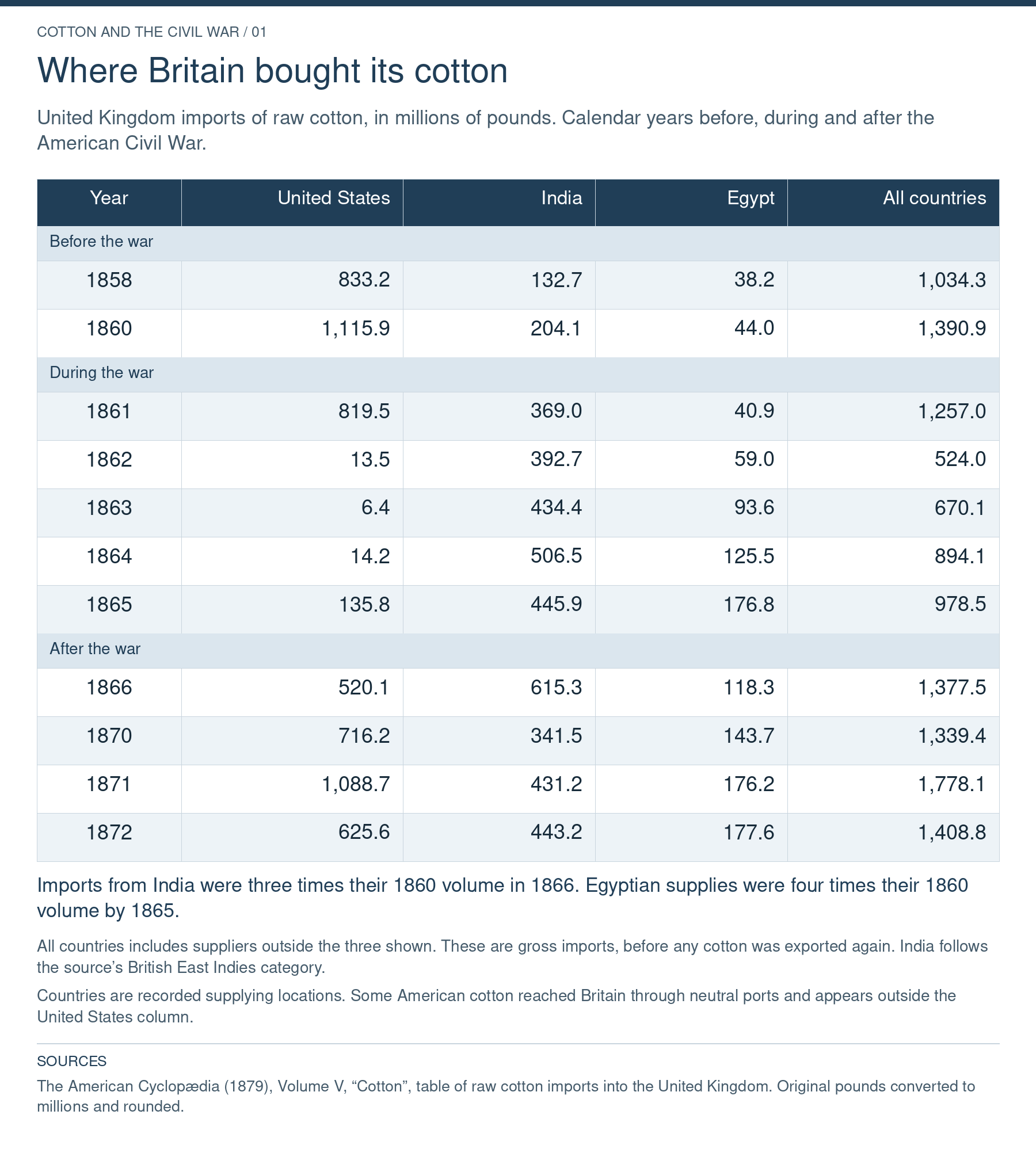
The Adjustment Was Neither Immediate Nor Painless
That is precisely why the episode matters. A supplier can inflict considerable short term damage while simultaneously giving its customers an overwhelming incentive to escape its influence. Higher prices make previously unattractive sources worth developing; merchants redirect finance, producers expand output and governments reconsider strategic dependence.
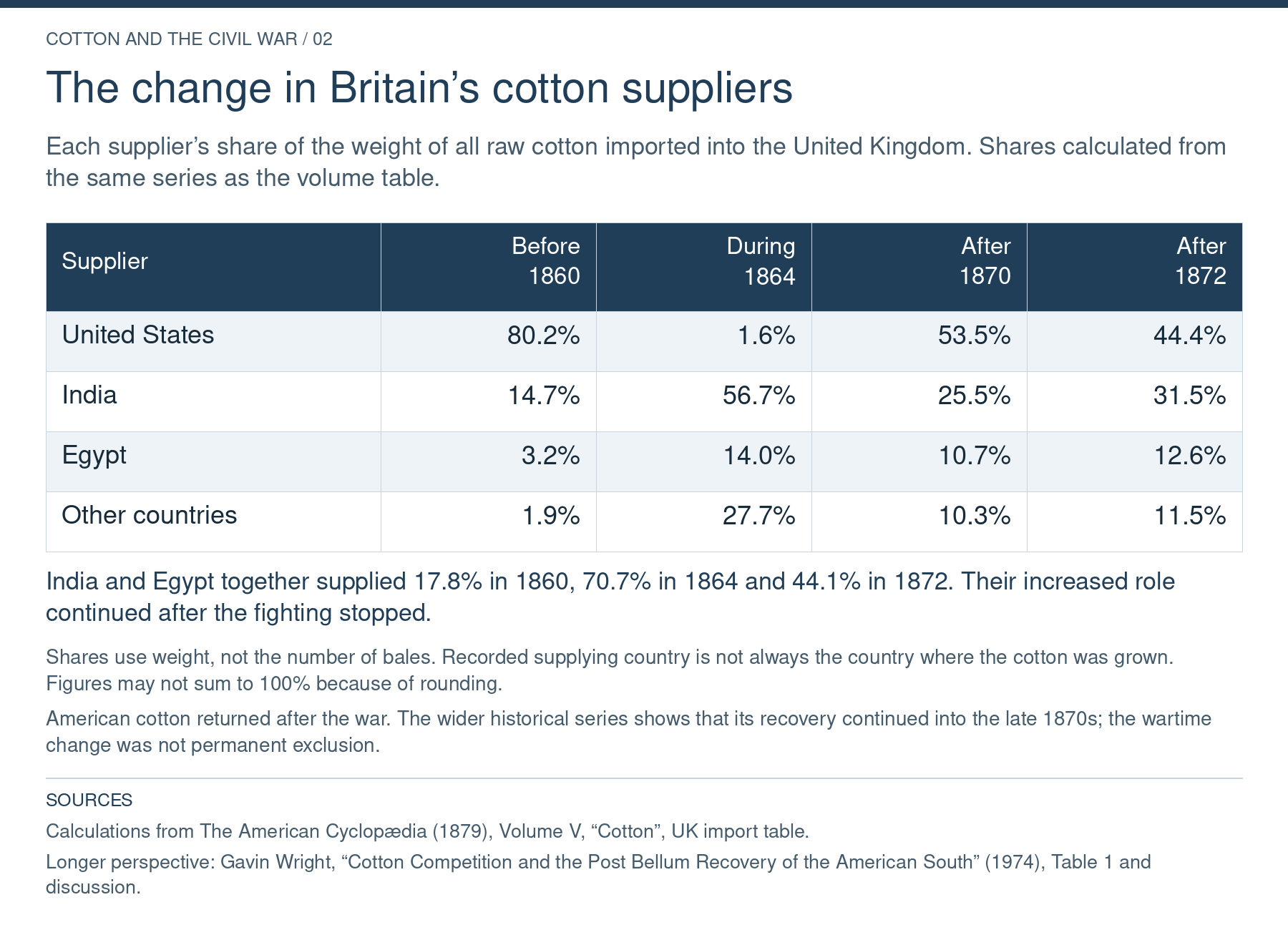
The resulting opportunities carry dangers of their own. Wartime cotton demand encouraged expansion elsewhere, and expectations of renewed American supplies helped trigger falling prices and financial panic as the war approached its end. India and Egypt belong in this account as participants in a global reallocation of production and capital, with new opportunities and new exposure to cotton prices.
The Market At Work
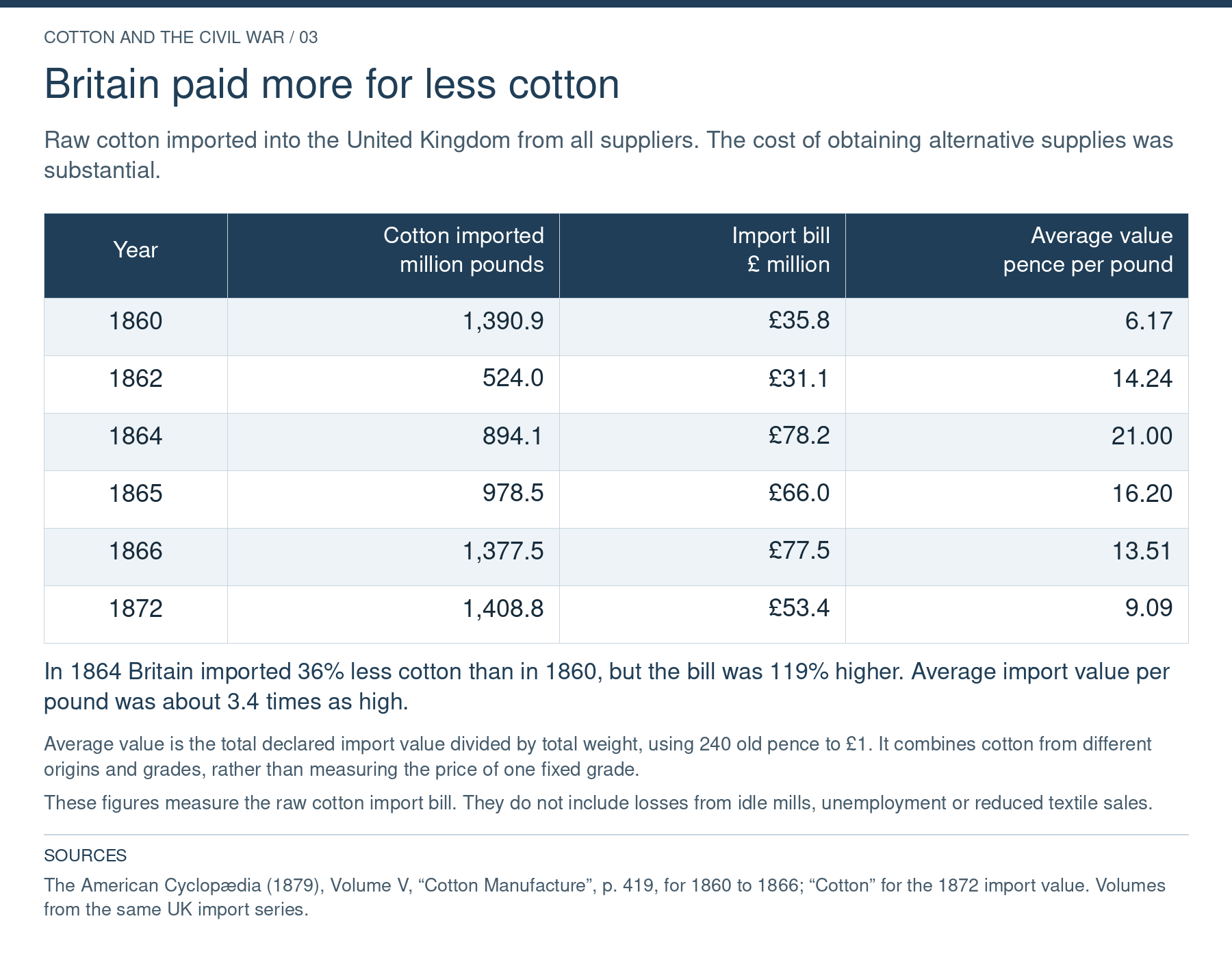
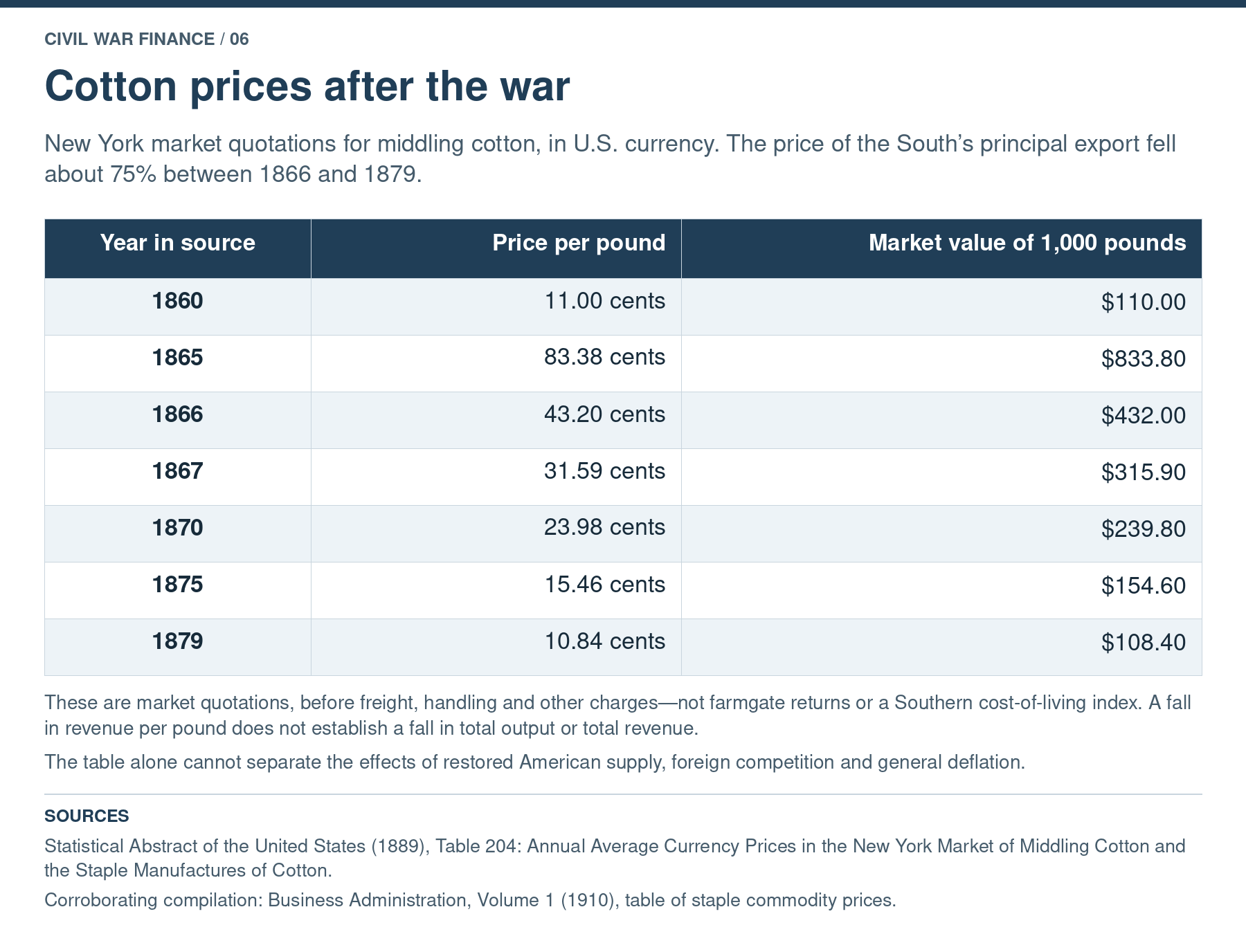
The figures show how costly that adjustment was. In 1864, Britain imported about 36 per cent less cotton than in 1860, yet its import bill was more than twice as large. Alternative supplies mattered enormously, but finding them did not make the disruption cheap. Nor did the change permanently exclude American cotton: Southern exports recovered substantially after the war.
The British Empire’s Story of Slavery: A Journey From Sugar to Cotton to Finance
This video gives useful background to the Civil War and connects Britain’s slavery, manufacturing and financial interests. The narrator is seemingly no fan of the Empire, but is relatively fair overall. I will return to the finance story in later essays.
Britain abolished its slave trade in 1807. The 1833 Slavery Abolition Act ended slavery in most British colonies from 1834, although compulsory apprenticeship continued until 1838. The government allocated £20 million to compensate slave owners. The formerly enslaved received no compensation. The borrowing was later consolidated into government bonds finally redeemed in 2015.
Human Nature At Work
Yet Britain was sending sailors to suppress the Atlantic slave trade while its mills bought American slave grown cotton. British demand and finance helped sustain the plantations supplying it. Banning the trade in people and banning trade in what those people produced were different propositions. Stopping a slave ship off Africa did not stop an auction in America.
The sacrifice involved in suppressing the slave trade was real, and so was Britain’s continuing commercial dependence on slavery. Southern leaders expected that dependence to compel British intervention when war came. They mistook a powerful commercial interest for an overriding national purpose.
Lincoln and the Cotton Famine
In Defence Of the Heroic British Worker
You know it is easy to get stuck into past Empires, whether in the West or the East. Regular readers will know I don’t hold back. Every now and then, though, we need reminding of the ordinary people. This is one such moment.
The cotton famine brought America’s war into British kitchens. Mills fell silent, wages disappeared and families queued for charity. Yet on 31 December 1862, workers gathered at Manchester’s Free Trade Hall to support Lincoln and urge the abolition of American slavery. Lincoln replied in January, acknowledging their suffering and praising their “sublime Christian heroism”.
American donors also sent practical help. The George Griswold reached Liverpool on 9 February 1863 carrying around 15,000 barrels of flour, along with bacon, bread and other provisions. Cotton had crossed the Atlantic to keep the mills working; now food crossed it to keep their workers alive.
But ‘Sublime Christian Heroism’ Nonetheless
On 10 March, hungry crowds in Manchester’s Stevenson Square stormed carts carrying relief bread after organisers turned its distribution into a public ceremony. Some loaves were hurled at the speakers and officials. They needed something to eat, not another speech.
In nearby Stalybridge, replacing cash relief with vouchers provoked riots in which relief stores were broken into and their contents scattered into the street. Troops helped restore order.
Support for the Union among British workers was real, but it was neither unanimous nor unconditional. People could oppose slavery while bitterly resenting the hunger, dependence and humiliation that the cotton famine had brought into their own homes.
A Small Problem: How to Finance a War
Britain’s refusal to intervene left the Confederacy to turn cotton into money under blockade. The Union had a different set of financial opportunities. Both governments still needed to turn their promises into food, weapons, transport and wages.
The video below is exceptional and I highly recommend it:
The North: Borrow, Tax And Print
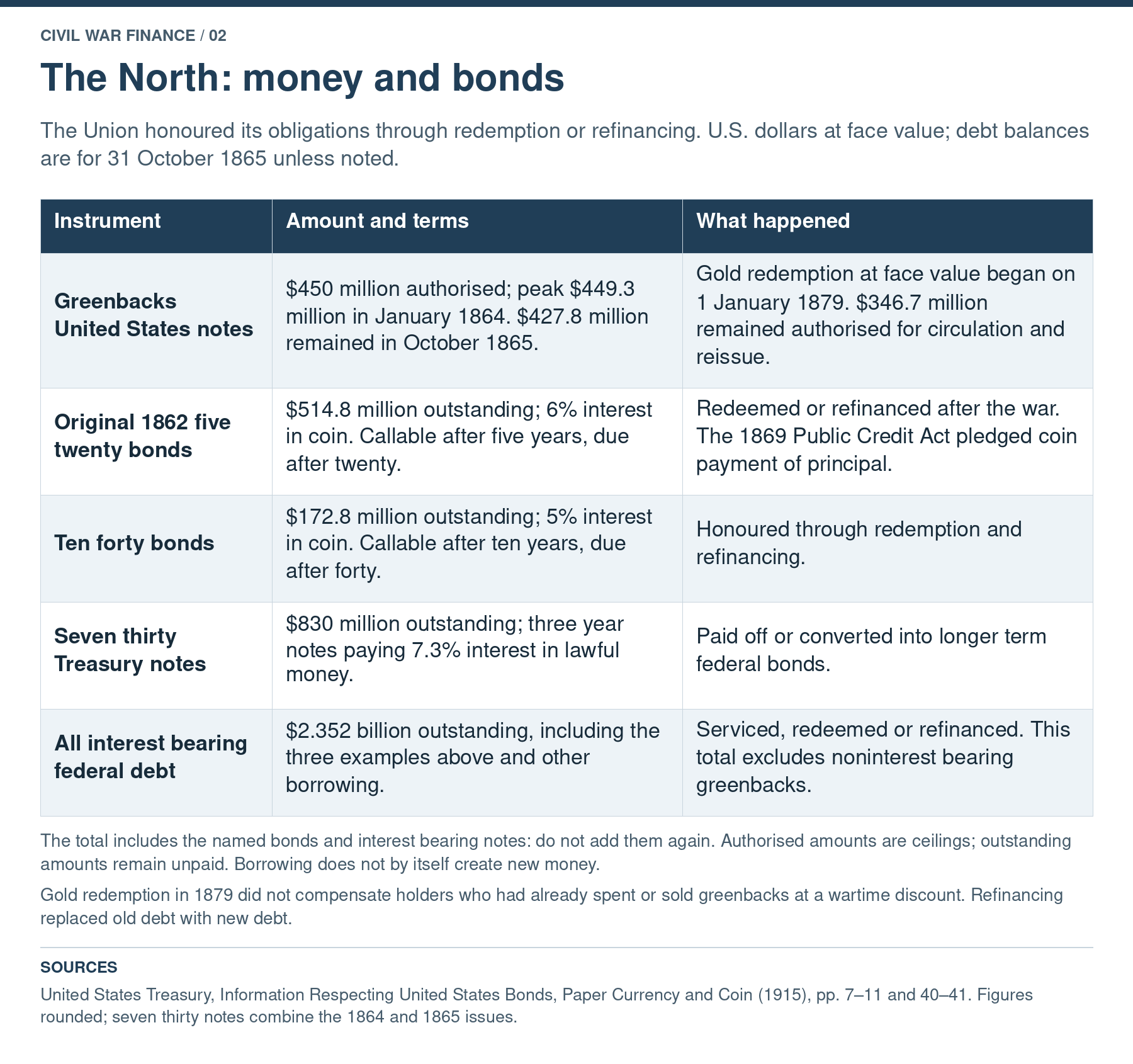
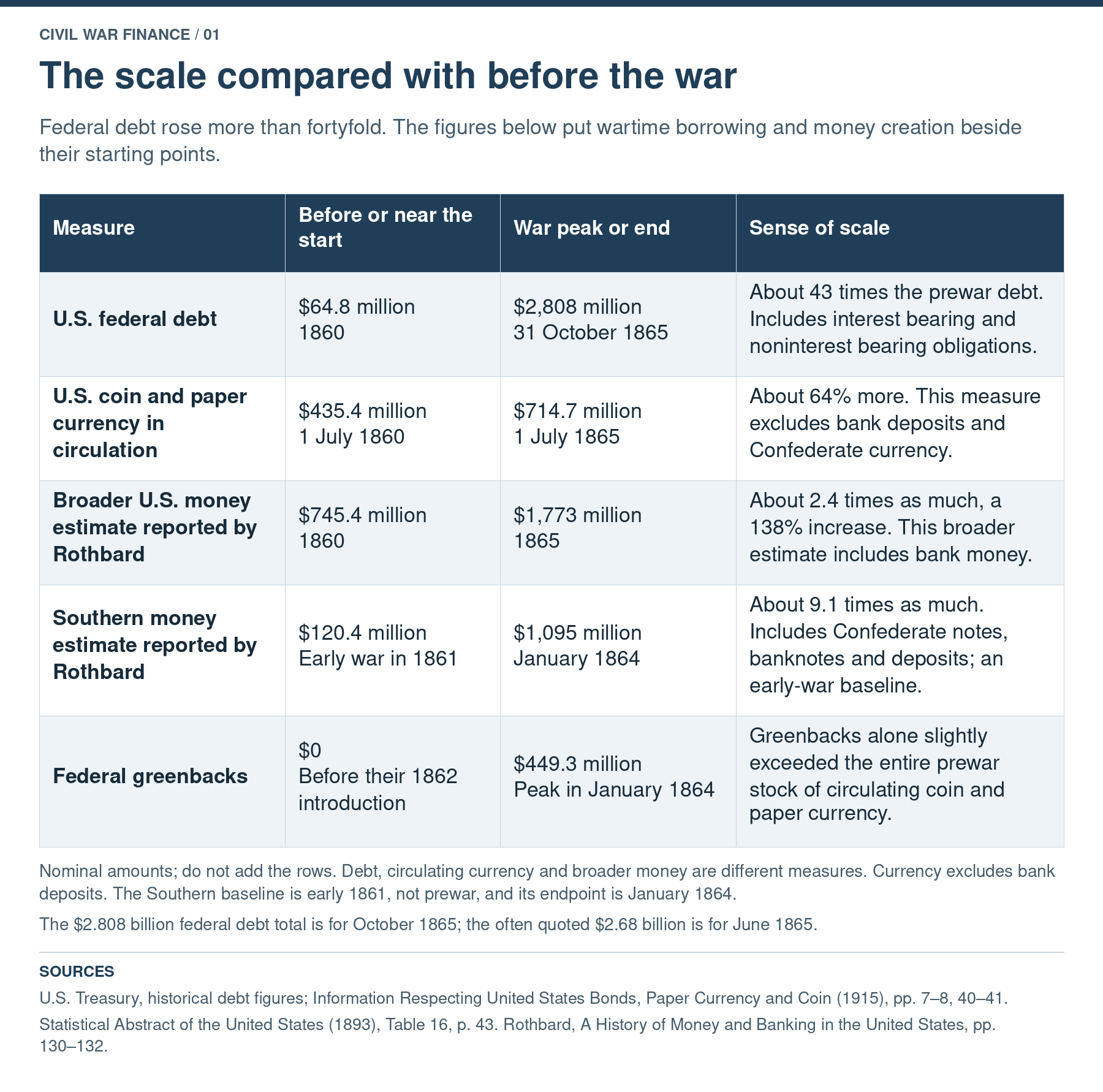
The Union financed the war through taxes, borrowing and newly issued money. Bonds, promoted by Jay Cooke and others, supplied much of the funding. Investors received promises of repayment with interest; Washington obtained money to spend immediately.
The dollar already existed. Before the war, banknotes and federal debt were denominated in dollars within a system based on gold and silver coin. The First and Second Banks of the United States issued notes promising coin, but these were bank obligations. Even the Treasury’s Demand Notes of 1861 initially promised payment in coin.
The Greenbacks
In February 1862, Lincoln authorised something different: United States Notes, commonly called greenbacks. These were Treasury paper dollars that holders could not exchange for gold or silver on demand. Their support came from federal credit, acceptance for most taxes and a law requiring creditors to accept them for most debts. The government could now pay with paper without first obtaining the coin to redeem it.
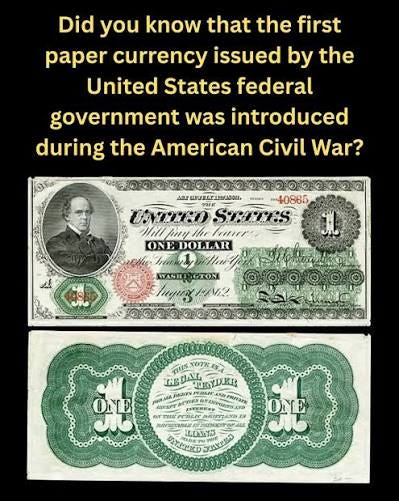
There was an instructive exception. Import duties and interest on federal debt remained payable in coin. Soldiers and suppliers could receive paper while bondholders received their interest in coin. Paper for some. Gold for others. Making a paper dollar legal payment did not stop it losing purchasing power.
The National Banking Acts of 1863 and 1864 added another mechanism. Participating banks bought federal bonds and deposited them with the Treasury as security for their banknotes. Washington gained buyers for its debt; banks earned interest and could issue currency against those bonds. These banknotes circulated alongside greenbacks, which remained direct Treasury obligations.
The South: Cotton Bonds and Confederate Paper
The Confederacy hoped cotton would bring foreign support and money. But withholding exports sacrificed income, while the Union blockade made cotton increasingly difficult to sell abroad. Wealth in plantations could not readily pay for imported weapons.
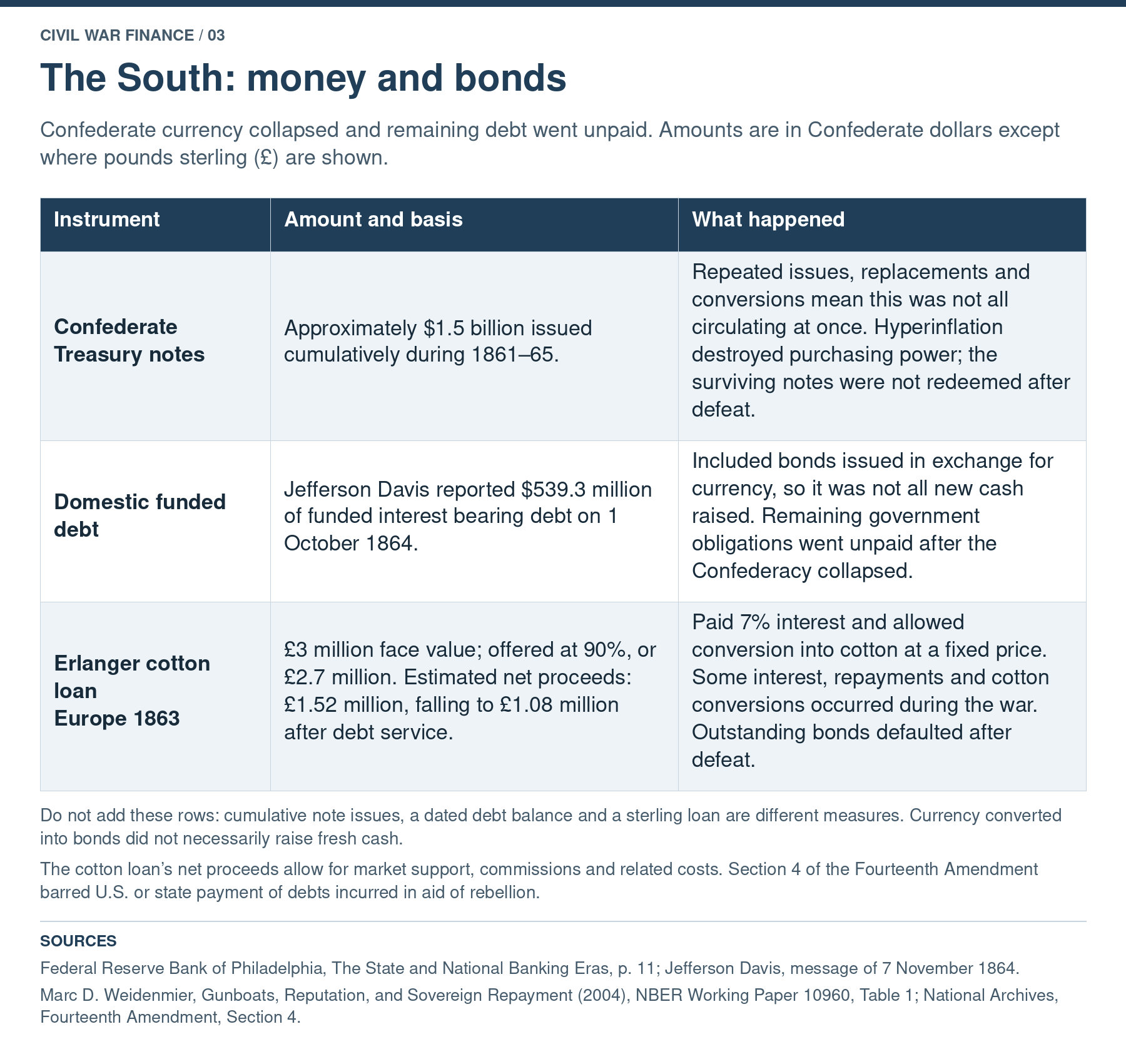
The 1863 Erlanger loan offered European investors bonds paying 7 per cent interest, with an option to exchange them for cotton at six pence per pound. The £3 million issue was denominated in sterling or francs, distinct from Confederate dollars. Scarce cotton promised handsome profits, provided investors could obtain it and get it through the blockade.
The Confederate Note
Cotton in a Southern warehouse was not the same thing as cotton delivered to Liverpool. Fees, market support and interest payments also reduced the proceeds available to spend.
The Confederate War Bond in Sterling or Francs
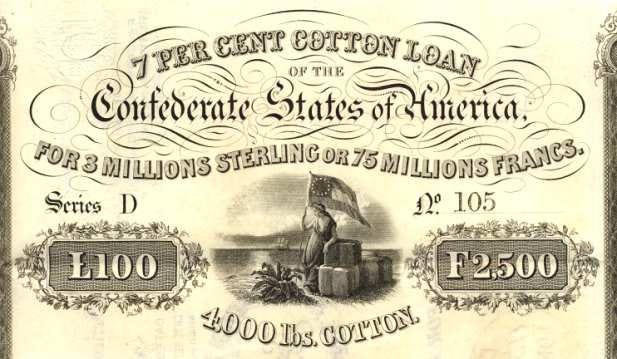
Perhaps the most interesting feature of the bonds was not any of those terms already described, since they were standard for speculative bond issues in the 19th century, but rather the convertible aspect of the bonds. The Erlanger loan, as the issue was called, was redeemable in cotton within six months after the conclusion of the war at a rate of eight bales, each roughly 500 pounds, per £100 in face value of the notes. This equated to a conversion price of just six pence per pound of cotton, an extraordinary discount when prices in Liverpool, Britain’s cotton textile center, were as high as twenty-four pence at the time.
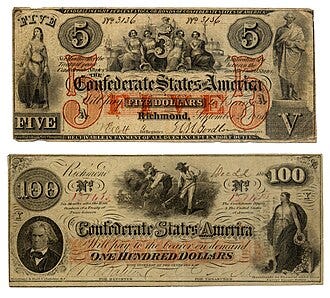
At home, weak tax collection and limited borrowing drove increasing reliance on printing money. The notes exposed the gamble: those issued in 1864 promised payment two years after a peace treaty with the United States. Repayment depended on the Confederacy surviving. The government also took a tenth of specified agricultural produce as tax from 1863 and compelled people to supply the army.
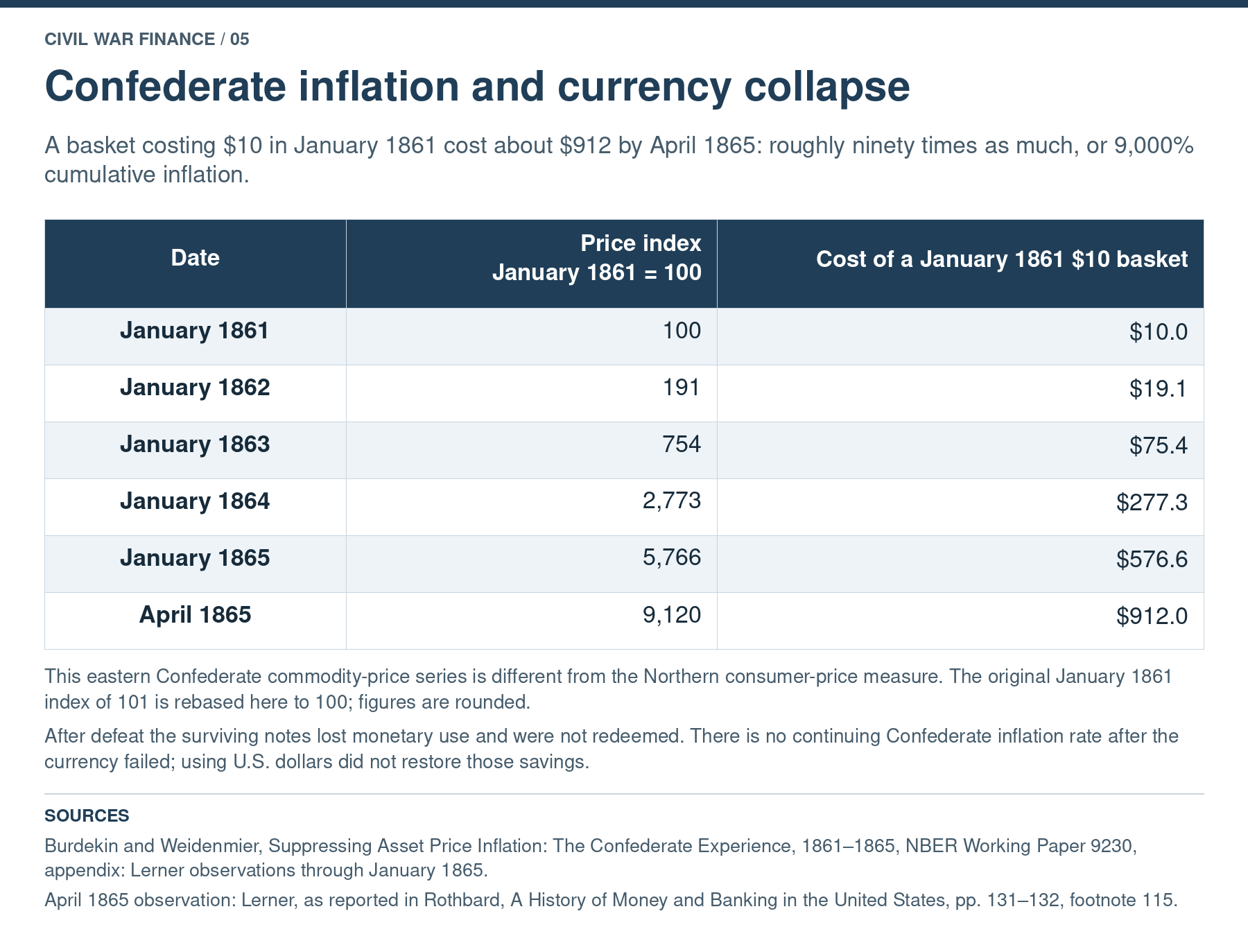
More paper competed for fewer goods as war disrupted production and transport. Prices rose, the government printed more, and military defeats weakened confidence in eventual repayment. Printing could meet a bill expressed in Confederate dollars; it could not restore their purchasing power. By the end, the currency was approaching worthlessness. Cotton had failed to secure British intervention, and paper could not replace the resources the South was losing.
The Inflation Wash Up
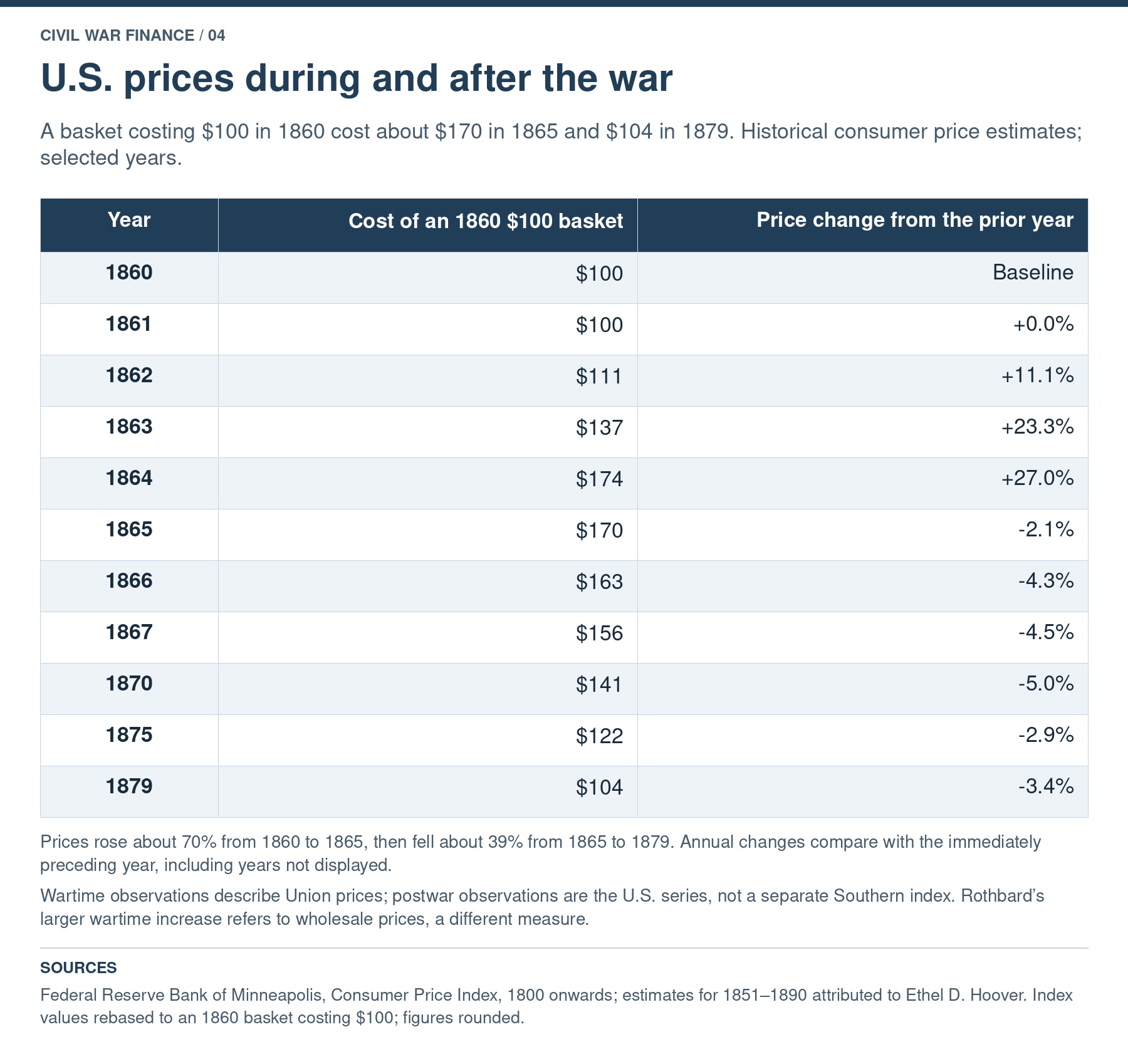
I don’t really need to describe the following three tables. I hold the truths of more money means more inflation to be self evident.
The Aftermath: Which Promises Survived?
The Union survived and honoured its federal debt. Confederate currency and bonds became worthless as promises of repayment: their government disappeared, and Washington refused to assume its debts. Section Four of the Fourteenth Amendment protected lawful United States public debt while declaring Confederate debts and claims for the loss of enslaved people illegal and void.
Both governments had exchanged paper promises for real resources. Only one survived to honour them. Printing the promise had been the easy part.
Is the U.S. Dollar Constitutional?
The constitutional question was whether Congress could force creditors to accept its paper. At the Constitutional Convention in 1787, delegates had removed an express power to issue “bills of credit”. Oliver Ellsworth wanted to “shut and bar the door against paper money”. Madison also distinguished issuing government notes from making them compulsory payment.
Supporters argued that Congress’s borrowing and war powers authorised greenbacks. They also noted that the Constitution expressly restricted states’ paper money powers without imposing the same prohibition on Congress.
Opponents argued that this supplied no authority to force paper upon creditors. The emergency explained why Washington wanted the power. Whether it constitutionally possessed that power would become a battle for the Supreme Court after the war.
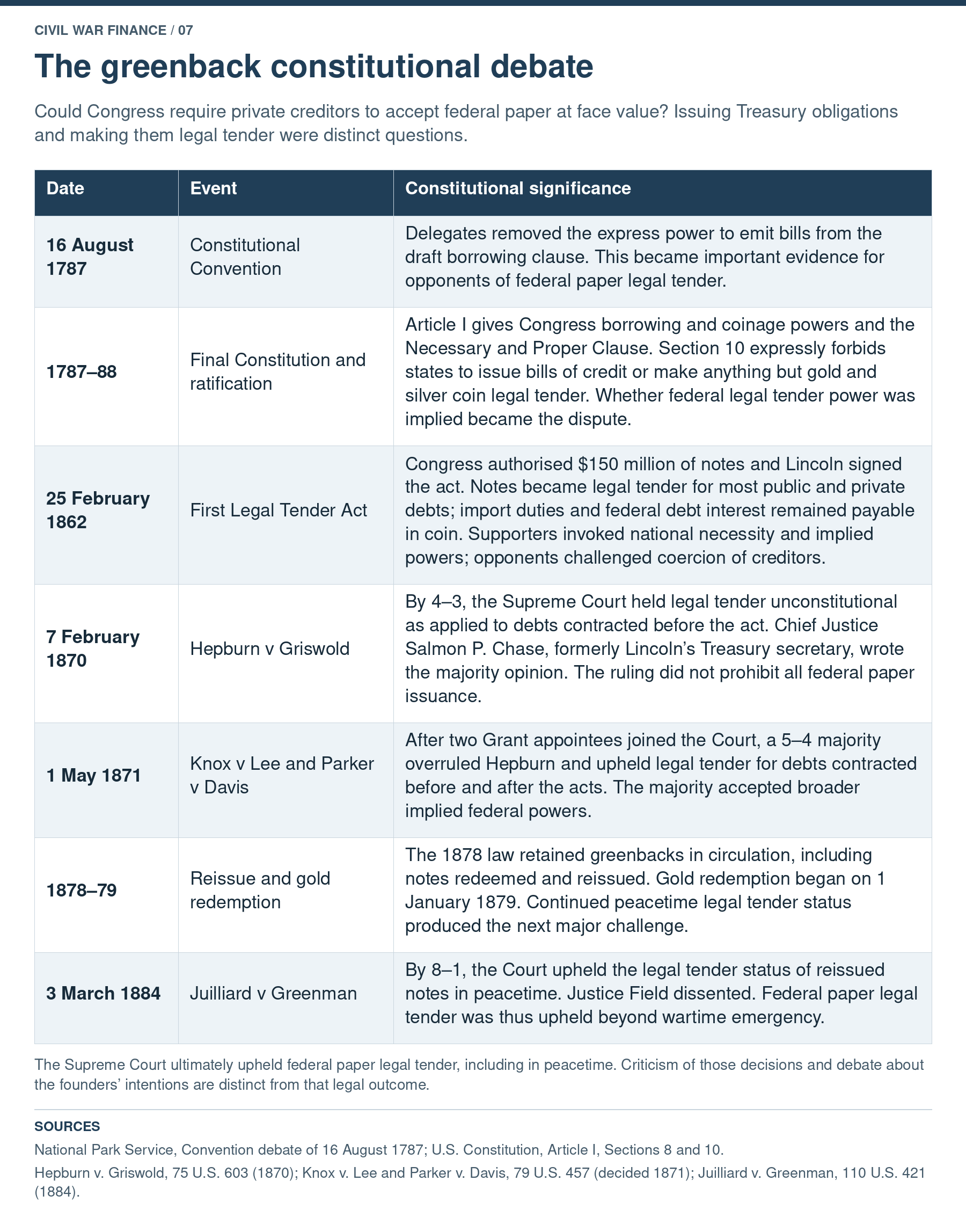
Victory left the greenback’s constitutionality unresolved. In 1870, the Supreme Court ruled against forcing creditors to accept greenbacks for debts contracted before the 1862 law. Remarkably, Chief Justice Salmon P. Chase, Lincoln’s Treasury secretary when greenbacks were introduced, delivered the judgment.
The Court reversed itself in 1871, then upheld federal legal tender power in peacetime in 1884. A power defended as a wartime necessity had become part of ordinary government.
Gold redemption was a separate question. Under the Resumption Act of 1875, the Treasury accumulated a gold reserve and began redeeming greenbacks on 1 January 1879. A holder could exchange $100 in paper for $100 in gold coin, although the reserve covered only part of the notes outstanding. This restored convertibility. It did not compensate people who had received depreciated paper and spent it during the war.
The greenback had established a lasting precedent: Washington could issue paper that creditors had to accept even when holders could not demand precious metal in return. Today’s Federal Reserve notes, first issued in 1914, are a different instrument, but that precedent helped prepare the way. Returning to gold changed what greenbacks could be exchanged for. It did not undo the government’s legal tender power.
The war changed both the sources of an essential industrial input and the state’s powers over money. Britain needed replacement cotton; governments needed resources to keep fighting. The connection between disrupted supplies, financial pressure and expanding government power remains with us today.
How a War in America Starved An Empire
All the WEFers should be forced to watch the video below: A Clockwork Orange Style. And remember there is no greater free trader than me. But at least I can still “see what you see”.
In this documentary, we explore the dramatic story of the Cotton Famine, a devastating global economic crisis triggered by the American Civil War. When the Union blockade cut off the world’s primary supply of raw cotton from the Confederate South, Britain’s massive textile industry was plunged into chaos, leading to widespread unemployment and social unrest. We’ll uncover how this crisis forced a monumental shift in global trade, spurred imperial expansion, and forever reshaped the supply chains of an essential commodity, proving that even localized conflicts can have catastrophic worldwide economic repercussions.
Oil Offers a Modern Version Of This Problem
In Iran’s case, the critical vulnerability extends to the passage of other countries’ exports through the Strait of Hormuz. The 2026 disruption prompted greater use of alternative pipelines, stock releases, additional supplies from other producers and adjustments by refiners. Those responses reduced the damage without making the interruption harmless.
The economic lesson resembles the cotton crisis: dependence creates immediate exposure, while disruption accelerates efforts to find alternatives. The country threatening supply must consider how much future business and future influence its customers will spend money to remove from its reach.
Are You Taking Note, China
Rare earths and pharmaceuticals reveal another dimension: dependence can lie several stages behind the finished product. China’s strength in rare earths extends through processing and magnet manufacture, so opening a mine elsewhere does not by itself establish an independent supply chain.
The International Energy Agency (IEA) records records that Chinese export restrictions disrupted downstream manufacturers and that alternative processing and manufacturing capacity remains a constraint.
Pharmaceuticals present a related problem through dependence on overseas active ingredients. A domestic factory can still be vulnerable if an indispensable input comes from a narrow range of foreign suppliers. Security therefore requires examining the entire production chain.
Commercial dependence also raises the contradiction we saw in Britain’s purchases of slave grown cotton.
Cotton Of All Things. When Will We Ever Learn?
Before we congratulate ourselves on having escaped this contradiction, consider our trade with China. The US Department of Labor identifies forced labour involving Uyghurs and other Muslim minorities in supply chains producing cotton and clothing, tomato paste, polysilicon for solar panels, aluminium used in car parts, and PVC used in flooring and pipes. Cotton, remarkably, is still part of the story.
The United States has imposed restrictions on imports linked to Xinjiang forced labour, while Australia raises concerns about abuses there and maintains extensive trade with China, its largest trading partner.
The tension between moral opposition and commercial dependence remains familiar: condemning forced labour is easier than disentangling an economy from the supply chains through which its products reach us.
Fine. There is one thing facing commercial reality but really…
Todays Elites and the Nineteenth Century British Worker
We have seen how British workers supported the abolition of slavery even while going hungry. What was on the menu at the dinner for Xi when he received his standing ovation in San Francisco?
A Greenback For Lincoln’s Thoughts On This
For Every Reaction, There’s a Counter-reaction
The contradiction now extends into competing legal demands. America’s Uyghur Forced Labor Prevention Act presumes that goods produced wholly or partly in Xinjiang, or by listed entities, are inadmissible. Importers seeking to overcome that presumption must provide clear and convincing evidence that forced labour was not used.
On 7 April 2026, China introduced regulations against what it calls improper foreign extraterritorial jurisdiction. Under these rules, implementing or assisting foreign measures identified through China’s procedures as improper is prohibited, subject to authorised exceptions.
Between a Rock and a Hard Place
Authorities can issue blocking orders, and breaches can attract fines and restrictions on trade, data transfers and other activities. These provisions create a mechanism through which complying with a foreign requirement can expose a company to penalties in China.
Companies can face demands to prove that forced labour was not used while risking Chinese penalties for complying with foreign measures Beijing has designated improper. Commercial dependence becomes a legal trap, giving businesses another reason to find alternative suppliers.
Taiwan and China. A Civil War Analogy.
Semiconductors provide the most powerful comparison. A conflict or blockade affecting Taiwan could transmit a regional military crisis into industrial disruption across countries far removed from the fighting, much as the American Civil War reached British mill towns. Taiwan would be the threatened supplier, and the consequences would spread through its customers.
The economic mechanism is comparable, potentially with much broader industrial reach; the scale and duration would depend on what production and shipping survived. Advanced chip capacity also takes years to establish. TSMC’s expansion in Arizona, alongside its substantial manufacturing base in Taiwan, illustrates the attempt to reduce that geographical exposure before a crisis makes adjustment urgent.
The Globalists Are Not Just Clueless. They Are Dangerous.
America’s effort to rebuild strategic manufacturing can therefore be understood as a contemporary application of a lesson visible in the cotton famine: the cheapest arrangement during peace may carry costs that emerge only during conflict. Additional domestic or allied capacity has a price, but so does being unable to obtain an essential input.
That is why the complacency of the so called Free Traders and defenders of the Rules Based International Order matters. Commercial dependence does not guarantee political cooperation.
They also seem to quite like war and are not too keen on democracy. Those pesky peasants can get in the way of their grand plans. Anyway, I digress.
This Brings the Argument Back To Keynesian Economics
Export disruption weakens earnings and the ability to purchase supplies; replacement capacity requires investment, skills, equipment and time. Governments can finance adjustment through taxation, borrowing or monetary expansion, but issuing purchasing power cannot instantly create the missing productive capacity.
Remember during Covid that all we needed to do was increase money and government spending and somehow the economy would be saved. This example is as good as any. In these circumstances no amount of government spending, can solve the situation. You need real resources to move to new uses.
The Fighting Stops. The Bill Remains.
Slavery was abolished, and Washington emerged with vastly greater financial power: an enlarged federal debt, new tax institutions and a national banking system. Emergency arrangements had acquired institutions, beneficiaries and constituencies of their own. The government could now command resources on a scale unimaginable to its prewar Treasury.
Returning to gold did not remove greenbacks from circulation or restore the institutional world that had existed before the war. The arguments over contraction, repayment and the meaning of a dollar continued to shape the monetary politics that followed.
Uncomfortable Lessons
For this story, the lessons are already uncomfortable. Taxation, borrowing and money creation allow governments to obtain resources; none makes those resources free. Constitutional decisions determine who can compel payment. Monetary decisions influence what that payment is worth.
The gold rushes expanded the supply of monetary metal. The Civil War expanded the state’s power over monetary promises. Its institutions survived the emergency, ready for the next government that needed more power.
The Answer Is…I Don’t Know the Answer
As for why we keep repeating these moral inconsistencies, then and now, I don’t have an answer. Perhaps the lesson is that we humans are complex beasts.
Finally, for the young ones out there who are wondering about the main title. See below for the most famous line in movie history!
Mr. O'Shannassy: Great essay. These similarities between pasts and present economic lessons as this does between cotton and rare earth etc. is great insight.
In your essay you make the following statement: "The borrowing was later consolidated into government bonds finally redeemed in 2015." Do you have a citation for this fact? I am fascinated by this. In one of your past essays you make a similar statement about English debt during the Napoleonic war. No doubt you've done your research but I couldn't find much online about it. Thanks.
Great insight in this one, especially the explanation on monetary expansion and unavoidable lags in resource reallocation. Lags are an issue across the board in economics. The lessons for our current time especially for Australia with such a narrow export base are timely if not terrifying!